












Best Laser Engraver for Leather and Leather Patches
Your objective, when choosing a laser engraver for leather engraving, should be to choose one that produces clean, detailed, consistent leather engravings without excessive scorching or burning. It must also provide just enough power, sufficient workspace, and speed for your intended projects and production volume.
Laser Engravers For Leather: The Two Types To Choose From
If you are looking for a laser engraving machine primarily or exclusively for leather laser engraving, you are effectively limited to choosing between a CO2 laser and a diode laser engraver. Which of these two you choose depends on:
- The type(s) and volume of leather you are working with,
- Whether you intend to engrave or cut,
- Other practical factors like your available workspace, ventilation, etc.
Diode vs CO2 vs. Fiber Laser Engravers For Leather: Which Should You Choose?
- CO2 laser engravers are the gold standard for leather because they handle both fast engraving and clean cutting of thicker hides efficiently. CO2 lasers are the best laser engravers for leather if you need production speed and heavy cutting.
- But if you are new to leather laser engraving and are doing it as a hobby, a diode laser will suffice. Entry-level 10W or higher diode options work well for surface engraving and light cutting, though they are slower than a CO2 machine.
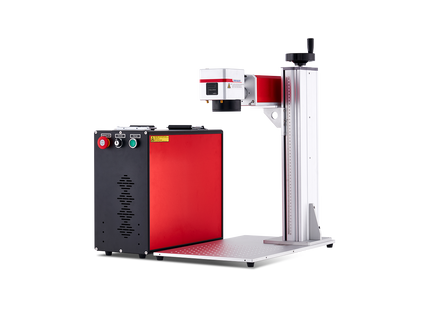
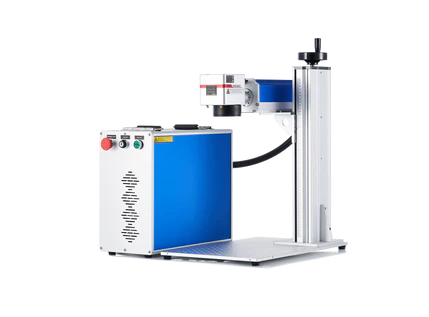
- Fiber laser engravers are also used for leather, but mostly by advanced leatherworkers for high-speed, dark surface marking on small leather goods. They are specialized and are more expensive.
In general, most small businesses cutting or engraving logos, names, text, wallets, belts, etc., use CO2 laser engravers for leather. Meanwhile, if you are a hobbyist, a more affordable entry-level diode laser engraver will allow you to perform the same operations on a smaller scale (albeit at a much slower pace) but without breaking the bank.

What Makes a Good Laser Engraver For Leather? Key Features
Apart from the type of laser, there are further considerations to keep in mind when deciding which is the best laser engraver for leather. Consider the smell, for example: burning leather produces a notorious, long-lasting stench, so whether you are choosing a diode or CO2 laser engraver for leather, a fully enclosed system with upgraded exhaust ventilation is mandatory.
There are about three principal features that make a good laser engraver for leather: it must have the facilities for smoke containment, char mitigation, and wavelength compatibility. The best laser engravers for leather are those that provide an excellent combination of all three features, without sacrificing one or the other.
1. Smoke Containment: It Must Have Robust Ventilation and Full Enclosures
Many experts in leather laser engraving agree on one thing: smoke containment is the single most critical feature in a laser engraver for leather. Leather produces an incredibly potent, long-lasting stench of burning hair and flesh, so a laser engraver needs to have full enclosure and an exhaust fan to deal with that:
- Full enclosure: Open-frame lasers will quickly fill your home or workshop with toxic, unbreathable smoke. A tight machine enclosure is required to trap the fumes.
- Upgraded exhaust fan: Inline duct fans (like those from AC Infinity) are highly recommended to force smoke out of a window. The tiny stock exhaust fans built into cheaper lasers are rarely enough.
2. High-Volume Air Assist is Paramount
Air assist is a pneumatic pump that shoots a constant stream of compressed air directly at the laser focal point. Here is why it is a non-negotiable in a laser engraving machine for leather:
- Char prevention: It instantly blows away smoky soot and resin before they can settle onto the surrounding leather grain.
- Fire safety: Leather can easily catch fire or melt if heat builds up. A powerful air assist setup cools the material down and suppresses flare-ups.
3. The Laser Type (Wavelength) Must Suit Your Goals
The choice of the laser source changes what you can achieve on leather surfaces:
- CO2 lasers (10,600 nm Wavelength): This is widely considered the "gold standard" for professional leather work. A CO2 laser engraver excels at fast, smooth vector cuts through thick, heavy tooling hide (like 4–6 oz veg-tan, a standard leather-thickness measurement) without leaving sticky residue.
- Blue diode lasers (450 nm Wavelength): Very good for surface engraving on leather. Leather fibers absorb blue laser wavelengths incredibly efficiently. You can get crisp, dark, high-contrast imagery on top layers, though diodes struggle to cleanly slice through thicker hides.
4. It Must Be Compatible With LightBurn
For a laser engraver for leather, compatibility with LightBurn is almost a must. In fact, the advice from experienced makers is usually to skip any proprietary laser software and get a machine compatible with LightBurn. Here are two reasons why:
- You will need to use material testing grids: Leather properties vary widely between hides. LightBurn allows you to generate automatic test matrices to map out the exact power and speed needed to achieve deep dark brown marks versus subtle scoring.
- Better layer control: This lets you easily separate intricate engraving paths from final perimeter cutting passes in a single automated job.
5. Variable Z-Axis / Focus Adjustment
Hides rarely lie perfectly flat and often bow upward when heat is applied, threatening to knock your focal length out of calibration. Features like automatic height adjustment or easily calibrated manual focus pins ensure the laser beam remains sharp across irregular, organic surfaces.

OMTech's Best Laser Engravers For Leather
In general, diode laser engravers and entry-level CO2 laser engravers are considered to be the best laser engravers for leather. However, which laser engraver is best for leather depends heavily on whether you are primarily engraving detailed surfaces or cutting thick hides.
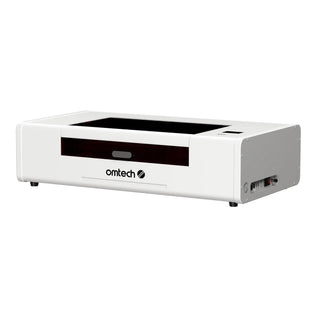
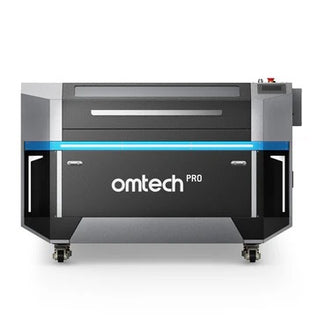
1. OMTech Polar Lite 55W CO2 Laser Cutter & Engraver
The OMTech Polar Lite 55W is highly praised for production-level leatherwork because its 55W CO2 tube effortlessly cuts through thick veg-tan leather without excessive charring. The fully enclosed, smart desktop setup makes it significantly safer and easier to vent the toxic, foul-smelling smoke compared to open-frame diode setups.
2. OMTech Turbo-535 50W CO2 Laser Cutter and Engraver
The OMTech Turbo 535 CO2 Laser Engraver is an OMTech favorite frequently cited as an excellent mid-tier, fully enclosed desktop CO2 option. It features a built-in exhaust fan and air assist, which community members note are crucial for keeping front-facing char at a minimum and blowing away debris for cleaner leather edges.
Best Laser Engravers For Hat Patches
Choosing a laser engraver for leather and a laser engraver for hat patches are not the same thing. For leather hat patches, CO2 lasers and galvo fiber laser engravers are generally the better choice.
- CO2 laser engravers are best for efficient batch cutting and engraving.
- Galvo/Fiber lasers are best for ultra-fast engraving if you buy pre-cut patches.
Recommended Laser Engravers For Leather: Types and Models
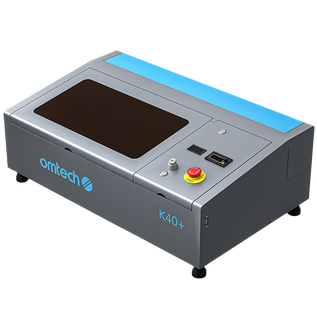
- CO2 Gantry Lasers (40W+ CO2 units): CO2 lasers are the gold standard for starting a patch business because they can both engrave high-detail text/logos and cleanly cut through thick leather hide in one go. For starting, the OMTech K40 Plus (40W, 300x200mm, £559.99) is a low-cost entry point; for bigger batches, the OMTech Turbo-535 (50W, 500x300mm, £1,499.99) gives you more working area.
- Diode Lasers: Budget-friendly, but significantly slower at cutting and deep engraving. Good if you only plan to make a small volume (around 25 patches a day).
- Galvo / Fiber Lasers: Extremely fast for engraving pre-cut leather patches, but poor at cutting out new shapes, meaning you must buy blanks already cut to size.
Laser Engravers For Leather vs Laser Engravers For Hat Patches: What are the Differences?
A general laser engraver for leather is a versatile workshop machine that cuts and etches many materials, while a leather hat patch engraver setup is a specific workflow optimized for bulk-producing, sizing, and cleaning small leatherette or veg-tan patches.
General Laser Engravers for Leather
- Versatility: Handles varied goods like wallets, journals, belts, and patches.
- Machine Types: CO₂ gantry systems, diodes, and fiber lasers depending on the hide or synthetic material.
- Capabilities: Can cut thick veg-tan leather, score stitch holes, and deep-engrave complex shapes.
- Scale: Ranging from hobbyist desktop units to large industrial cabinet machines.
Leather Patch Engravers for Hats
- Focused Application: Tailored strictly for small badge sizes (typically 3" circles or 3x2" rectangles).
- Material Focus: Frequently utilizes laser-safe faux leather (leatherette) that changes color cleanly under heat, avoiding toxic PVC fumes.
- Workflow Accessories: Relies heavily on alignment jigs for batch production and lower air-assist settings (5–10%) to prevent charring.
- Finishing Steps: Requires post-processing cleanup (like dish soap pre-treatments or cleaners such as LA's Totally Awesome) to remove heavy soot.
Important Tips For Engraving Hat Patches
- Material choice is paramount: For hat patch laser engraving, most creators use laserable leatherette (PU leather) because it yields a clean, consistent contrast when burned and avoids the toxic fumes associated with certain treated real leathers.
- Ventilation: Good exhaust and ventilation are mandatory. Engraving leather produces strong, unpleasant odors and hazardous smoke.
- Application/Pressing: To attach patches to hats (like Richardson 112s), it is better to use a small hat heat press set around 270°F–290°F for 15 to 30 seconds. Use a silicone pressing sheet and stuff the crown of the hat (with a rolled sock or beanbag) to prevent creases and avoid scorching.

Key Leather Engraving Rules
1. Never Use Faux Leather Unchecked
Do not engrave synthetic or "pleather" unless it is certified PVC-free. Burning PVC releases highly toxic chlorine gas that can destroy both your lungs and your machine. Stick strictly to real, natural leather (like vegetable-tanned).
2. Managing the Smell
Leather smells like burning hair when processed. Upgrade to an inline duct fan to pull fumes out of a window, and let finished pieces air out for a few days.
3. Masking and Orientation
To prevent smoky smudges and resin staining on the surface, you can try applying masking tape over the engraving area or flipping the leather "grain side down" when executing heavy cuts.
4. Air Assist is Mandatory
Always run a strong air assist pump while processing. This blows the flame away instantly, drastically reducing the char and edge burning on your material.

Final Thoughts on Choosing a Laser Engraver For Leather
Choosing the best laser engraver for leather isn't just about power; it's about smoke containment, air assist, and wavelength working together, since leather punishes any machine that skimps on one of them. CO2 lasers remain the go-to for serious cutting and production work, while a diode laser is a perfectly capable starting point for hobbyists focused on surface engraving.
Whichever route you take, a fully enclosed machine, a real exhaust setup, and LightBurn compatibility will do more for your results than any single spec on a spec sheet, and for hat patches specifically, matching the machine to the workflow (batch cutting vs. engraving pre-cut blanks) matters just as much as the laser type itself.
You may also be interested in this complete guide on personalizing wallets with a laser engraver.