













How Laser Technology Is Changing Small Business Manufacturing in 2026
Most Aussies still picture laser technology as something reserved for heavy industrial zones—automotive plants, aerospace facilities, or defense contractors operating multi-million dollar machines behind thick safety glass.
That picture is completely out of date.

Today, the exact same core technology is driving local sign shops, boutique jewellery studios, suburban backyard sheds, school STEM labs, and small-scale metal fabrication workshops right across Australia. The machinery has become highly compact and accessible, the software has grown intuitive, and the commercial applications are expanding rapidly.
Here is what laser technology looks like on the frontline of small-business manufacturing right now.
The Laser Cutting Signage Business: Low Overhead, High Margins
The sign-making industry offers a perfect example of how accessible laser hardware can revolutionise a traditional trade.
Before digital laser cutters became affordable, local sign makers relied heavily on manual routers or hand tools. Complex vector curves took ages to map out, tiny custom lettering was a nightmare to clean up, and the edge finish on acrylics depended entirely on the operator's sanding and polishing skill.
A CO₂ laser transforms the entire production line. You load your vector file, input your power and speed settings, and let the machine execute identical pieces flawlessly. An intricate piece of corporate signage that used to demand an hour of intensive manual labor is cut cleanly in eight minutes. Acrylic edges emerge with a glass-like, flame-polished finish straight out of the bed—no secondary sanding or flame-torching required.
The commercial benefit shifts immediately:
-
Lower labour costs per production piece
-
Higher job turnover per day
-
Premium margins on bespoke, high-end custom orders
A single mid-range CO₂ setup allows a local business to produce custom wedding acrylics, retail point-of-sale displays, architectural lettering, and timber real estate signage back-to-back. The laser doesn't care about the application; it simply reads the file, handles the material variation, and gets to work.
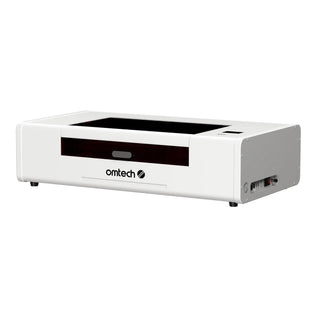
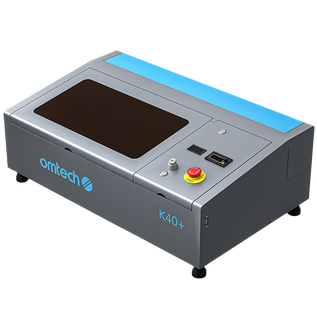
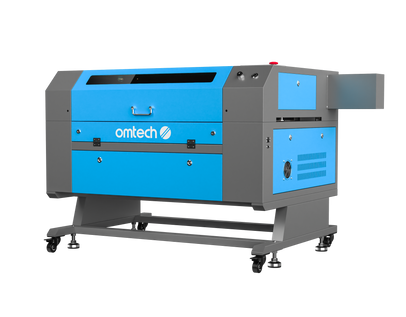
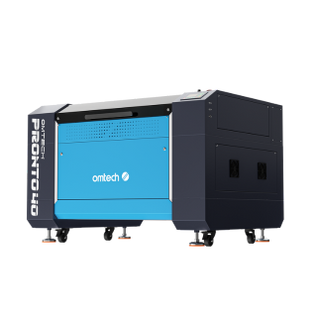
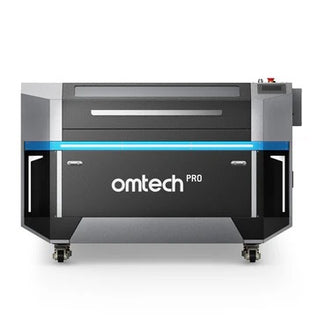
To run production like this daily, local sign businesses typically opt for the OMTech 80W to 130W cabinet lasers, providing the necessary bed size to accommodate standard acrylic and timber sheets without awkward pre-cutting.
LightBurn Laser Software: The Hidden Game-Changer

While hardware advancements get all the headlines, software evolution is what actually opened the door for everyday business owners. You no longer need a degree in CNC programming to operate a commercial laser, largely thanks to LightBurn.
LightBurn collapses the design, editing, and machine control into one unified workspace. The workflow is incredibly straightforward:
Historically, this required a disjointed chain of separate applications. You would design your file in one tool, export it, open it in clunky proprietary machine software, and manually input raw parameters. If a single vector line was misaligned, you had to trace the error back through three different programs.
With OMTech machines utilizing LightBurn software, an operator can go from a customer's raw design file to a finished physical cut in under ten minutes. For small business owners juggling tight deadlines, this brief learning curve is a massive competitive advantage.
Workshop Safety: The Part You Cannot Skip
Operating industrial-grade tech in a small business or home studio environment demands respect. It is vital not to gloss over safety parameters; Class 4 lasers—the classification for both CO₂ and fiber sources—are highly powerful devices.
The laser beam itself can cause irreversible eye injury in a fraction of a second if unshielded. While enclosed machine chassis keep the physical beam safely contained, proper atmospheric management is just as critical.
Building a compliant, safe commercial workshop layout requires structural discipline:
-
Enclosed Chassis: Only operate lasers with protective viewing windows and interlocks.
-
Inline Extraction: Vented directly outside to the open air or channelled through an advanced multi-stage carbon fume filtration system.
-
Strict Material Auditing: Never process unknown plastics or composite materials without confirming their chemical composition. PVC must be banned from your workshop entirely as it creates destructive hydrochloric acid gas.
-
Eye Protection: Ensure any nearby staff wear wavelength-specific safety glasses during calibration or maintenance sequences.
Industrial Context: EV Laser Technology & Engineering Trickle-Down
While large-scale automotive manufacturing feels distant from a local workshop, the technology lines are deeply intertwined.
The explosive growth of the Electric Vehicle (EV) market has driven massive global investment into fiber laser engineering. EV production relies heavily on specialized fiber lasers for high-precision battery cell welding, joining structural copper busbars, and marking permanent traceability codes onto automotive parts. Because these battery welds must survive millions of vibrations while managing high electrical currents without overheating, traditional welding methods aren't up to the task.
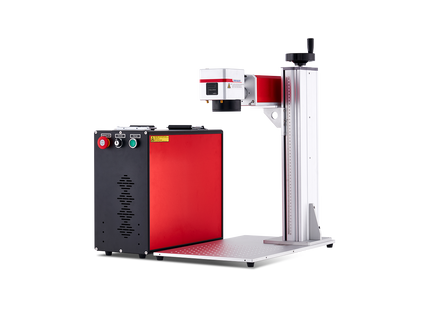
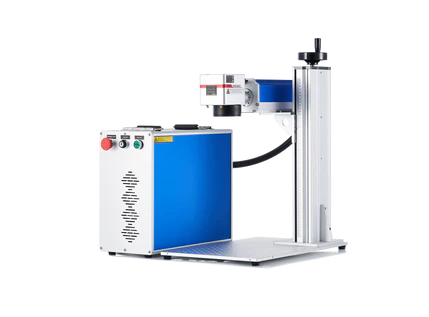
This heavy industrial research directly benefits small-scale fabricators. The massive demand for high-reliability EV production lines has perfected the beam quality, power efficiency, and solid-state longevity of the compact fiber sources used today. When you fire up an OMTech Galvo Fiber Laser to mark stainless steel tumblers or compliance tags in an Australian workshop, you are utilizing hardware refined by the cutting edge of global automotive engineering.
STEAM Education: Where Tech Meets Tomorrow's Trades
Laser engraving is rapidly establishing itself across Australian high school makerspaces, TAFE fabrication labs, and community innovation hubs as an essential STEAM (Science, Technology, Engineering, Arts, and Maths) asset.
The loop between a student’s digital vector design and a physical, tangible object provides immense educational value. Students who struggle to connect with abstract mathematical or engineering theory often completely re-engage when those coordinate lines translate directly into an intricately interlocking timber model or a clean acrylic prototype.
Rather than just an arts-and-crafts tool, running a mid-range, fully-enclosed CO₂ laser introduces students to genuine manufacturing workflows:
-
File optimization and vector node editing.
-
Material science (understanding grain density and absorption rates).
-
Industrial safety protocols and spatial extraction mechanics.
The New Reality for Small Manufacturers
When you connect these structural shifts, the picture becomes clear:
-
Local sign makers deploy CO₂ technology to produce commercial displays at a speed and price point that used to require massive outsourcing capital.
-
Aussie metal shops use high-speed Galvo fiber marking to apply permanent, asset-traceability barcodes, aligning their small business with major national supply-chain compliance rules.
-
Boutique craft brands scale up their weekly shipping capacity by letting LightBurn handle complex multi-layered engraving jobs while they focus on marketing.
Laser technology has broken out of the heavy industrial complex. It is no longer an exclusive tool for giant factory floors—it is a practical, accessible asset scaled perfectly to the budget, space, and growth ambitions of the modern Australian maker.
Frequently Asked Questions
What are the primary business uses for lasers in Australia?
Local businesses predominantly utilize them for custom architectural signage, personalised leatherwork, engraving timber grazing boards, industrial compliance metal tagging, promotional merchandise, and precision acrylic fabrication.
Does LightBurn work across all laser types?
LightBurn is highly versatile and acts as the operating system for virtually all OMTech CO₂ laser engravers, as well as select Galvo fiber metal marking machines, allowing you to manage your entire workshop from one interface.
Can I run a commercial laser out of a home garage safely?
Yes, absolutely. However, you must ensure the machine is positioned on a stable workbench, wired to an appropriately rated circuit, and hooked up to a high-volume inline fan that exhausts all processing fumes completely clear of your residential windows and neighbours.
Why can't a CO₂ laser cut bare metals?
It comes down to light physics. The 10,600nm infrared wavelength generated by a CO₂ laser is highly reflective against raw surfaces like aluminum or polished stainless steel. The energy bounces off rather than being absorbed. To mark or engrave raw metals efficiently, you require a 1064nm Fiber laser.