













How to Start a Laser Cutting Business in Australia
Your goal when starting a laser cutting business should be to build a repeatable and profitable production business that uses laser cutting to turn materials into products customers are willing to pay for, while keeping production costs low enough to scale.
The good news is that many of the principles used by successful laser cutting entrepreneurs can serve as a useful starting point. These generally centre around identifying a profitable niche, choosing the right laser machine for your materials, controlling production costs, and pricing your products to maintain healthy profit margins.
You can think of these as the foundational pillars of building and running a successful laser cutting business in Australia: find a unique product or underserved niche before buying a machine, choose equipment around your actual production requirements, and treat your laser as a business tool, not a money printer.

1. Find Your Niche First
The key to succeeding in the laser cutting business in 2026 is to avoid niches or products that are already saturated. Generic products such as basic engraved chopping boards, standard signs, and other easily replicated items can face significant online competition.
Instead, focus on opportunities where your laser can solve a specific problem or create something difficult to replicate. For example:
- Solve specific problems: Focus on custom local jobs, replacement brackets, unique home décor, architectural models, personalised products, or B2B branding rather than competing solely on generic products in crowded online marketplaces.
- Combine your skills for more creative projects: Laser cutting becomes even more valuable when combined with woodworking, leathercraft, signage, furniture making, or event planning. Combining different skills can help you create products that are more difficult for competitors to copy.
- Look for local demand: Australian businesses, wedding suppliers, pubs, restaurants, cafés, retailers, tradespeople, schools, and event organisers can all provide potential customers for customised laser-cut products and services.
The goal isn't necessarily to find a completely new product. It is to find a specific customer with a specific problem that you can solve profitably.
2. Define Your Business Model
Before investing in a laser cutter, decide how you intend to make money from it. Most laser businesses fall broadly into two categories: product-based businesses and service/job-shop businesses.
- Product-based model: You design and manufacture unique, repeatable products such as custom cabinet components, complex 3D wood assemblies, personalised décor, signage, or merchandise. The advantage is that you can build margin into both the product and the design, although developing profitable products requires creativity and upfront testing.
- Service/job-shop model: You provide custom cutting, engraving, etching, or fabrication services for other businesses and customers. This model can work particularly well when you establish relationships with local businesses that need repeat orders. B2B clients can provide more predictable revenue than relying exclusively on one-off consumer orders.
You can also combine the two. For example, you might sell your own range of personalised products online while accepting cutting and engraving jobs from local businesses.

3. Choose the Laser Cutting Machine You Need, Not the Machine You Want
Buying a laser machine for a business is a significant investment, so your equipment should be selected according to the materials, product sizes, production volume, and applications you actually plan to handle.
For a laser cutting business, your main options are a high-power diode laser, a 60W+ CO₂ laser, or a fibre laser cutting machine, depending on the materials you work with.
- Diode lasers (20W–40W): A relatively affordable starting point for applications such as light engraving and thin-wood cutting. However, they generally offer less cutting capability and throughput than higher-powered CO₂ systems.
- CO₂ lasers (60W+): A strong choice for businesses cutting and engraving wood, acrylic, plastics, and other non-metallic materials. Higher-powered CO₂ lasers can cut thicker materials more quickly, making them particularly useful when production volume matters.
- Fibre lasers: Fibre laser cutting machines are highly specialised machines primarily suited to businesses working with metal. They are generally unnecessary if your business focuses mainly on wood, acrylic, leather, or other non-metal materials.
Buying a Laser Machine for a Laser Cutting Business
A low-cost diode laser can be suitable for light engraving and smaller projects, but a CO₂ laser is generally a better choice if your business depends on faster and cleaner cutting of wood, acrylic, and similar materials.
Power also matters. Moving from a lower-powered machine to a 55W, 80W, 90W, or 100W+ CO₂ laser can significantly increase cutting capability and reduce the amount of time spent producing each item.
Before committing to a machine, consider visiting a local makerspace, fabrication workshop, or laser-focused community where possible. This can allow you to learn design software, understand laser workflows, and test your ideas before committing several thousand Australian dollars to equipment. You can check out many of OMTech showrooms in Australia for a free, no-obligation product demo session.
4. Establish a Legal and Safe Workspace
Whether you operate from a dedicated workshop, commercial premises, or your home, you need to consider the safety, insurance, ventilation, and legal requirements associated with running a laser business.
If you plan to operate a laser business from home in Australia, check your local council's requirements before setting up your workshop. Depending on your circumstances, you may need council approval, particularly if your business creates noise, fumes or vibrations, brings regular customers or suppliers to your property, requires modifications to your home, or involves activities that present health and safety risks.
- If you rent your property, you should also check your lease and obtain any required landlord approval.
- You should also determine which business registrations apply to you. Most Australian businesses need an Australian Business Number (ABN), while the registrations you need will depend on your business structure, location, and activities.

Fume Mitigation
Laser cutting and engraving can produce smoke, particulates, and potentially hazardous fumes depending on the material being processed. Your workshop therefore needs an appropriate method of controlling and removing these emissions.
For many installations, this means connecting the laser's exhaust system to a suitable external ventilation system. Where external extraction is not practical or permitted, a properly specified filtration system may be necessary.
Do not assume that a standard household air purifier is sufficient for laser cutting. Your ventilation or local exhaust ventilation (LEV) system should be selected around the machine, materials, workspace, and applicable Australian workplace health and safety requirements.
Australian businesses have duties under Work Health and Safety (WHS) laws to provide a safe working environment and manage workplace hazards. WHS requirements vary somewhat between states and territories, so check the rules that apply in your location.
Business Insurance
Don't assume that your household insurance automatically covers a laser business operated from your home. Australian government guidance notes that standard home insurance policies often do not cover business activities, so you should tell your insurer that you are operating a business from your property and check that your equipment and activities are appropriately covered.
Depending on your business and how you operate, you may also want public liability insurance, equipment or property cover, and other business insurance. If you employ workers, workers' compensation insurance may also be required under the rules in your state or territory.
Sole Trader or Company?
You also need to decide how your business will be structured.
- A sole trader structure is relatively straightforward and can be suitable for people starting a small business. However, as a sole trader, you are generally personally responsible for the business's debts and obligations.
- Alternatively, you can establish a company, such as a proprietary limited company (Pty Ltd). A company is a separate legal entity and can provide limited liability protection, although it also comes with additional administration, reporting, and compliance requirements.
Your business structure can affect your tax obligations, liability, administration, and ability to grow, so consider speaking with an accountant or qualified business adviser before making the decision.

5. Handle Logistics, Tax and Pricing
Once your equipment and workspace are established, your next challenge is making sure every order is actually profitable.
Calculate Your True Costs
One of the most common mistakes new laser businesses make is underpricing their work. Don't simply double the cost of your materials. Your pricing should account for:
- Material costs and waste
- Design and preparation time
- Machine operating time
- Labour
- Electricity
- Ventilation and extraction
- Equipment maintenance
- Replacement parts and consumables
- Packaging and postage
- Marketplace and payment-processing fees
- Rent or workshop costs
- Insurance
- Taxes and other business expenses
This is particularly important in Australia, where your advertised retail price may also need to account for GST if your business is registered.
Understand Australian GST
As of 2026, Australian businesses generally need to register for GST when their GST turnover reaches A$75,000 or more. If you expect your turnover to reach the threshold, you generally need to register within the required timeframe. Businesses below the threshold can also choose to register voluntarily.
GST is generally 10% on most taxable goods and services sold in Australia. If you are GST registered, you'll generally need to include GST in applicable sales, claim eligible GST credits on business purchases, and report your GST obligations through your Business Activity Statement (BAS).
Don't wait until you reach the threshold to think about GST. If you expect your laser business to grow quickly, understanding how GST will affect your pricing, cash flow, and margins from the beginning can help you avoid unpleasant surprises later.
You should also keep accurate business records and understand which expenses can be claimed as business deductions. The Australian Taxation Office provides specific guidance on expenses and deductions for different business structures.

6. Validate Globally, Sell Locally
Online marketplaces can give a laser cutting business access to customers throughout Australia, but they can also be extremely competitive. Rather than trying to compete purely on price, look for opportunities where your local presence, customisation, quality, or turnaround time gives you an advantage.
i. Design Original Products
Create original vector artwork and product designs instead of simply copying popular templates. Professional vector-design software can help you develop products that are easier to customise and reproduce.
AI tools can also be useful during the ideation stage, but make sure the resulting designs are suitable for commercial use and that you have the necessary rights to use any assets or content incorporated into your final product.
ii. Build Local Sales Channels
Don't overlook customers within your own area. Local markets, craft fairs, independent retailers, wedding and event suppliers, hospitality businesses, tradespeople, schools, property developers, and other small businesses can all become valuable sources of work.
For a new laser business, a handful of repeat B2B customers can sometimes be more valuable than hundreds of one-off online orders.
OMTech Pronto CO₂ Lasers for Your Laser Cutting Business
For a laser cutting business, 60W to 150W CO₂ lasers offer an excellent balance of cutting capability, productivity, and operating cost. While lower-powered machines can handle thinner materials, a 40W laser may take longer to cut materials in the 3–6 mm range, potentially limiting productivity and reducing your profit per working hour.
OMTech's Pronto Series CO₂ Laser Engravers (60W to 150W) are designed with small businesses and production-focused users in mind. These CO₂ laser cutters combine high engraving speeds, upgraded transmission systems, generous working areas, and features designed to help you produce more while maintaining consistent results.
With engraving speeds of up to 1,000 mm/s, Pronto machines are built to help you move through production jobs efficiently. Their upgraded transmission system also supports accurate movement and consistent results across detailed designs.
Another advantage is the machines' 8.7-inch maximum workpiece height, giving you more room to work with taller objects. This represents an 83% increase in workpiece height compared with previous designs, making the Pronto series more versatile for businesses working with a wider range of products.

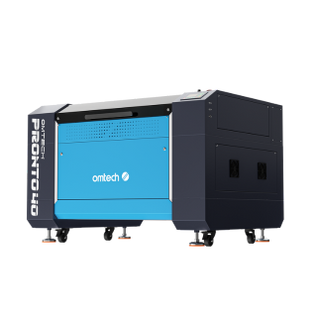
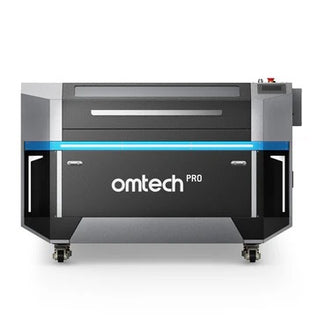
OMTech Pronto 40 90W CO₂ Laser Cutter and Engraver
The OMTech Pronto 40 90W CO₂ Laser Cutter and Engraver is a strong option for businesses looking for a production-capable machine without immediately moving to a much larger industrial system.
It features a 900 x 600mm working area, autofocus, and a maximum engraving speed of 1,000 mm/s. With 90W of CO₂ laser power, it can handle a broad range of cutting and engraving applications, making it suitable for businesses producing signage, personalised products, displays, décor, and other custom items.
For Australian customers, it's worth checking the machine's electrical requirements, plug configuration, delivery arrangements, warranty coverage, and after-sales support for your specific market before purchasing.
Why Choose OMTech Pronto Lasers for Your Laser Cutting Business?
Ruida Controller Compatibility
Pronto machines use Ruida digital controllers and are compatible with LightBurn, giving operators access to a familiar workflow for creating, preparing, and controlling laser jobs.
Fully Enclosed Cabinet
For businesses operating indoors, the fully enclosed cabinet helps contain smoke and fumes generated during laser processing. When properly connected to an appropriate exhaust system, the enclosure and extraction setup can help remove potentially harmful fumes from materials such as acrylic and leather from the workspace.
Australian businesses should still assess their individual ventilation requirements and comply with applicable WHS requirements rather than relying on the enclosure alone.
Front and Back Pass-Through Doors
Each Pronto machine features front and rear pass-through doors, allowing you to work with materials that are longer than the standard bed length. This can be particularly useful for cutting oversized plywood, acrylic sheets, and other long workpieces without requiring an oversized, room-filling laser bed.
For Australian workshops where floor space can be limited, this can be a particularly useful feature when you're trying to increase production capacity without immediately moving into much larger premises.
Together, these features make the OMTech Pronto series a practical choice for entrepreneurs who want to turn laser cutting and engraving into a productive business while keeping their equipment footprint manageable.

How to Choose a Fibre Laser Cutter for Business
If metalwork is part of your business plan, there are two main paths when it comes to fibre lasers: a high-power galvo fibre laser for marking and engraving, or a flatbed fibre laser cutting machine for sheet-metal cutting.
Which one you need depends on the size and scale of your business, the thickness of the metal you intend to cut, the dimensions of your workpieces, and your budget.
1. High-Power MOPA Fibre Lasers: Best for Metal Engraving, Marking and Light Jewellery Cutting
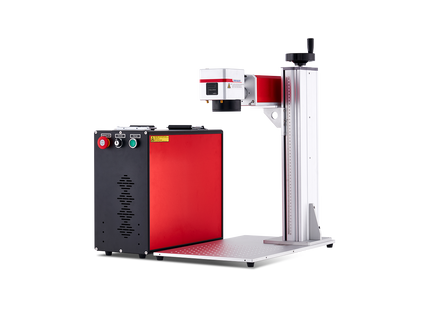
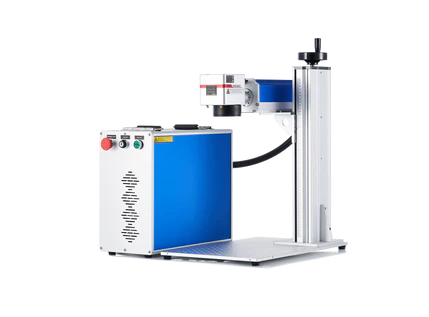
If your business focuses on metal engraving and marking, with light jewellery or thin-metal cutting on the side, a high-power desktop MOPA fibre laser, such as a 60W–100W JPT MOPA unit, can be a suitable starting point.
A 60W JPT MOPA fibre laser, such as the OMTech M-60 MOPA 60W Fibre Laser Engraver, is primarily designed for marking and engraving rather than heavy cutting.
That said, OMTech notes that with multiple high-frequency overlapping passes, a 60W or 100W MOPA unit can cut certain thin precious-metal blanks, including gold, silver, or brass jewellery pieces, up to approximately 1 mm thick.
That's enough for light jewellery and small token-cutting applications, but it is not a substitute for a dedicated metal-cutting machine if sheet-metal cutting is the primary focus of your business.
3. Flatbed Fibre Laser Cutters: Best for Structural Sheet-Metal Cutting
If your business plan requires cutting structural sheet metal, including full-size sheets of steel, you need to move up to a dedicated, high-power flatbed fibre laser cutter.
For Australian businesses, sheet-metal dimensions are generally specified in millimetres, although imperial dimensions such as 4 × 8 ft are still commonly used when referring to standard sheet sizes. A 4 × 8 ft sheet is approximately 2440 × 1220 mm.
The OMTech FC-22 1500W Fibre Laser Cutting Machine is a fully enclosed option with front and back pass-through and a built-in water chiller. It reaches a 27.56 in/s cutting speed and can cut through up to 0.2 in. stainless steel and up to 0.4 in. carbon steel.
For Australian readers, however, always check the manufacturer's current Australian-market specifications, electrical requirements, machine certification, installation requirements, and available support before purchasing industrial equipment.
Fibre Laser Types for a Laser Cutting Business, Summarised
| Business Need | Recommended Laser | Recommended Machine | Best For |
|---|---|---|---|
| Engraving and light jewellery/token cutting | 60W–100W JPT MOPA fibre laser | OMTech MOPA 60W Split Fibre Laser Engraver | Small businesses focused on metal engraving, marking, jewellery, and small tokens |
| Heavier metal engraving and light cutting | 100W JPT MOPA fibre laser | OMTech MOPA 100W Split Fibre Laser Engraving Machine | Businesses handling more demanding metal engraving and light cutting projects |
| Structural sheet-metal cutting | 1,000W+ flatbed fibre laser | OMTech FC-22 1500W Fibre Laser Cutting Machine | Businesses cutting thick, large steel sheets, including production work |
Final Thoughts on Starting a Laser Cutting Business in Australia
The businesses that make it past their first year in laser cutting tend to share a common pattern: they identify a specific problem or underserved market before choosing a machine, then match their equipment to that opportunity.
A diode laser won't get you far in a metal-fabrication niche, while a multi-kilowatt fibre cutter would be excessive for a business focused on jewellery engraving. Start by defining your niche, business model, production requirements, workspace, and budget. Once those are clear, choosing the right laser becomes much easier.
If metalwork is on your roadmap, be honest about what you actually need the machine to do. Marking and light engraving point towards a MOPA desktop fibre laser, while genuine sheet-metal cutting requires a dedicated flatbed fibre laser.
Trying to stretch a marking machine into a cutting role, or buying far more cutting capacity than your business needs, is one of the more avoidable ways a new laser business can waste its starting capital.
Most importantly, don't buy the machine first and then try to find a business for it. Find the customer, product, or problem first, and then buy the machine that allows you to solve it profitably.
You may also be interested in these wood laser cutting ideas you can explore as you launch your business.