














How to Print on Glass With a UV Printer
Glass is one of the most striking materials available for custom printing. Its clarity, smooth surface, and premium appearance make it a popular choice for signage, awards, retail displays, decorative panels, hospitality products, and branded business displays.
With UV printing technology, businesses can print full-colour graphics directly onto glass without the need for vinyl decals, screen printing, or complex finishing processes. The result is a professional, durable finish that offers outstanding visual impact while supporting short-run customisation and on-demand production.
In this guide, we'll explore how UV printing on glass works, the best practices for achieving professional results, and how businesses can use UV-printed glass products to create new revenue opportunities.
Why Glass Is Ideal for UV Printing
Glass has traditionally been one of the more challenging surfaces to decorate because it is completely non-porous. Conventional inks often struggle to bond with the surface, leading to smudging, peeling, or inconsistent results.
UV printing overcomes these limitations by using UV-curable inks that harden instantly when exposed to ultraviolet light.
Rather than soaking into the material, the ink forms a durable layer on the surface, producing:
- Sharp text and fine detail
- Vibrant colours
- High-resolution graphics
- Excellent opacity with white ink
- Premium gloss effects
- Fast production turnaround
Because the curing process happens immediately, finished pieces can be handled, packed, or installed straight after printing.
For businesses producing custom signage, awards, promotional products, or decorative glass panels, this significantly improves workflow efficiency.
Popular Applications for UV Printing on Glass

Glass printing is used across a wide range of industries and markets.
Popular applications include:
Business Signage
- Reception signs
- Office branding
- Door signage
- Wayfinding displays
- Corporate logos
Hospitality and Retail
- Menu displays
- Product information panels
- Retail branding
- Countertop signage
- Decorative partitions
Awards and Recognition Products
- Corporate awards
- Sports trophies
- Commemorative plaques
- Achievement displays
Interior Décor
- Decorative glass panels
- Wall art
- Printed splashbacks
- Architectural features
- Custom room dividers
Promotional and Personalised Products
- Photo panels
- Branded gifts
- Event signage
- Custom displays
- Limited-edition products
The premium appearance of glass often allows businesses to charge higher margins compared to traditional printed materials.
What Equipment Do You Need?
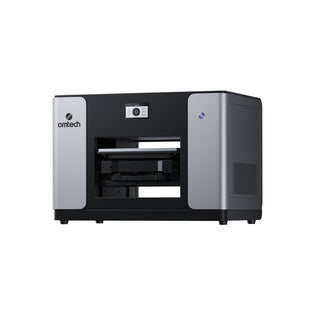
A flatbed UV printer is the key piece of equipment for glass printing.
The OMTech Spectra UV Printer is designed to print directly onto rigid materials such as:
- Glass
- Acrylic
- Wood
- Metal
- Plastic
- Leather
- Ceramic surfaces
Additional tools that help ensure consistent results include:
- Isopropyl alcohol
- Lint-free cloths
- Measuring tools
- Positioning guides
- RIP software
- Alignment templates
Because glass shows fingerprints and dust more easily than other materials, proper preparation is especially important.
Preparing Artwork for Glass Printing
The design process begins much like any other UV printing project.
After creating or importing your artwork, adjust the design to match the exact dimensions of the glass piece.
For best results:
- Measure the printable area accurately.
- Set artwork dimensions precisely.
- Position logos and text carefully.
- Leave sufficient margins where required.
One unique consideration with glass is viewing direction.
If the design will be viewed through the glass—such as a window sign or reverse-printed panel—the artwork should be mirrored before printing.
This allows the image to appear correctly when viewed from the opposite side while protecting the printed layer behind the glass surface.

Achieving Accurate Positioning
Like most flatbed UV printers, glass placement is controlled using positioning coordinates.
A common workflow is to create alignment guides using tape, jigs, or templates that allow each glass panel to be placed in exactly the same location.
Once the correct print position has been established:
- Future jobs become faster.
- Repeatability improves.
- Waste is reduced.
- Batch production becomes easier.
Many businesses create dedicated production templates for commonly used glass sizes to streamline ongoing work.
Tips for Better Glass Printing Results
While UV printing on glass is relatively straightforward, a few best practices can dramatically improve print quality and durability.
Clean the Surface Thoroughly
Dust, fingerprints, and oils can affect ink adhesion.
Always clean the glass with isopropyl alcohol and a lint-free cloth before printing.
Use White Ink Underlays
Glass is transparent, which can cause colours to appear washed out.
A white ink base layer helps create:
- Better colour vibrancy
- Stronger contrast
- Improved readability
- More professional results
Consider Adhesion Promoters
For products that will be handled frequently or exposed to moisture, an adhesion promoter may improve long-term durability.
Avoid Excessive Ink Build-Up
Multiple controlled layers generally produce more reliable results than a single heavy ink deposit.
Control Dust and Static
Glass can attract dust particles due to static electricity. Maintaining a clean workspace helps minimise imperfections.
Building a Repeatable Production Workflow
One of the biggest advantages of UV printing is consistency.
Once artwork placement, print settings, and positioning guides are established, the same workflow can be repeated across dozens or hundreds of products.
This makes UV printing ideal for:
- Corporate signage projects
- Award production
- Retail displays
- Franchise branding
- Promotional campaigns
- Custom product manufacturing
Because every design is digitally controlled, personalisation can be added without changing hardware or tooling.
Names, dates, logos, QR codes, and custom artwork can be updated quickly with minimal additional labour.
Why Glass Printing Makes Sense for Small Businesses
Glass products often command premium pricing while remaining relatively inexpensive to produce.
For Australian sign makers, promotional product suppliers, interior decorators, and custom product businesses, UV printing on glass offers several advantages:
- High perceived value
- Strong profit margins
- Fast turnaround times
- Customisation opportunities
- Professional appearance
- Scalability from one-off projects to larger production runs
This makes glass an attractive material for businesses looking to expand beyond standard signage or printed products.
Why Choose the OMTech Spectra UV Printer?
The OMTech Spectra UV Printer is designed to help small businesses produce professional-quality UV prints across a wide range of materials.
Key features include:
- High-resolution Epson print technology
- CMYK, white ink, and varnish support
- Automated maintenance systems
- Integrated ink circulation
- User-friendly OMTech Print software
- Compact flatbed design suitable for small workshops
These capabilities make it easier to produce consistent, high-quality results while minimising maintenance and downtime.
Final Thoughts
UV printing has transformed glass from a difficult-to-print material into one of the most profitable and visually impressive substrates available to modern businesses.
From office signage and retail displays to awards, decorative panels, and personalised products, UV-printed glass delivers exceptional quality with minimal production complexity.
With the right workflow and a capable machine, glass printing becomes a reliable, repeatable process that supports both custom orders and larger production runs.
Ready to expand your product range? Discover the OMTech Spectra UV Printer and unlock professional UV printing on glass, acrylic, wood, metal, and more—all from one versatile production system.