












The Laser Systems Modern Factories Are Using Right Now
Walk through a mid-sized Aussie engineering or fabrication shop today, and there is a very high chance you will spot a fiber laser running in the corner. It might be high-speed marking serial numbers onto machined components, or cutting through precision sheet metal—sometimes both, split across two dedicated machines working all day long.
Go back ten years, and that setup was a rare luxury down under. Today, it is simply the trade standard.

Industrial laser systems did not completely phase out traditional workshop machinery, but they have rapidly taken over tasks that used to rely on messy ink stamps, physical punch sets, or manual engraving tools. The shift happened because the workshop unit economics just make sense. It is faster, cleaner, completely free of chemical consumables for most jobs, and incredibly straightforward for training up new apprentices or floor staff.
Here is a look at what Australian manufacturers are actually running, why certain systems dominate the production floor, and how smaller boutique workshops fit into the modern landscape.
Fiber Laser Systems: The Industrial Standard for Metal Fabrication
If you ask any production manager in an Australian manufacturing hub what they use to mark metal, the answer is almost always a fiber system. Fiber lasers hit metallic surfaces at a specific wavelength (1064nm) that the material absorbs beautifully. The resulting mark is permanent, high-contrast, and achieved in seconds without inks, pads, or toxic chemical sprays.
Local production floors rely on fiber lasers for:
-
Serial numbers and tracking part IDs
-
Data matrix codes and high-density barcodes
-
Regulatory compliance markings across medical, automotive, and mining machinery
-
Logo etching and branding on finished metal items
-
Deep structural tracing before parts go out for powder coating or galvanising
On a busy shift, cycle speed dictates your profitability. Shaving a part marking cycle down from fifteen seconds to two seconds makes a massive difference to daily throughput. Modern fiber systems deliver this lightning-fast output without compromising clarity or readability.

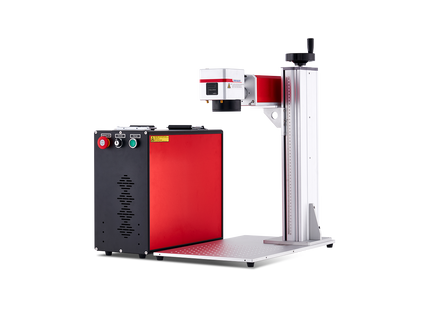
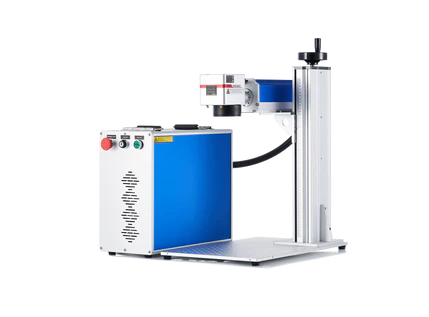
OMTech’s fiber laser marking collection spans from highly flexible split-desktop units to high-power industrial enclosures. The secret to their incredible processing speed lies in the Galvo (galvanometer) head design. Instead of moving a heavy gantry back and forth across a bed, the laser uses ultra-fast internal mirrors to direct the beam while the part stays completely stationary. You simply load the piece, mark it in an instant, and move on to the next.
Small-Batch Laser Production: Solving a Different Problem
Large-scale factories have massive footprints and corporate budgets, but that is only half the story of Australian manufacturing. The real growth is happening in small-batch workshops. A custom knife maker, local jewellery designer, or small engineering firm batching out 50 specialised components a day faces completely different challenges than a massive automated plant.
For small-batch jobs, your biggest enemy is setup time. If switching your machine software over between different design files takes ten minutes, you are losing money on a short 50-piece run. Modern machinery featuring streamlined software, integrated autofocus, and seamless vector file imports allows you to bypass manual focal adjustments entirely.
A flexible machine like the OMTech Galvo Fiber 20W, 30W, or 50W Autofocus Laser Marking Machine is engineered for rapid job switching. Local custom fabricators love these setups because they don't require a dedicated, full-time programmer to operate.
The other major advantage for small shops is material versatility. You aren't processing the same exact alloy all day long. One hour you might be marking anodised aluminium compliance plates; the next, you are etching logos into stainless steel tool handles. A high-quality fiber system adjusts to both with minimal fuss—a slight tweak to your power and speed settings in the software is generally all it takes.
Traceability: The Silent Driver Behind Laser Adoption
Outside the manufacturing sector, few people realise how much regulatory compliance drives modern workshop technology. Industries like defense, mining equipment, medical manufacturing, and aerospace operate under strict item traceability mandates. Every component must feature a permanent mark capable of surviving the part's entire operational life cycle—including exposure to extreme outback heat, heavy abrasion, grease, and industrial solvents.
Ink stamps fade, and adhesive labels peel off under harsh Australian conditions. Laser marks simply cannot be removed.
Material Integrity Note: According to industrial engineering standards, laser marking creates a permanent surface alteration without sacrificing the structural or mechanical integrity of the underlying alloy. In fields like aerospace fabrication, you cannot deep-stamp or mechanically engrave structural titanium parts without risking microscopic stress fractures. Laser marking solves this by keeping the component's structural integrity perfectly intact.
CO₂ Systems Still Rule the Non-Metal Side
While fiber lasers claim total dominance over metals, CO₂ laser systems remain the absolute authority for everything else. If your workshop processes plastics, hardwoods, leather, rubber, acrylic, fabrics, or foam packaging, CO₂ light physics is what you need.
-
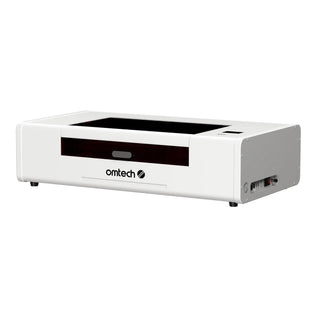
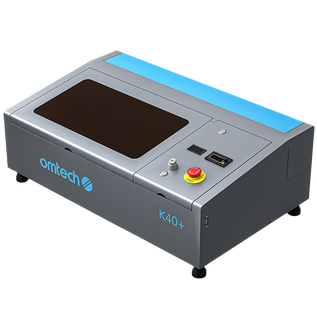
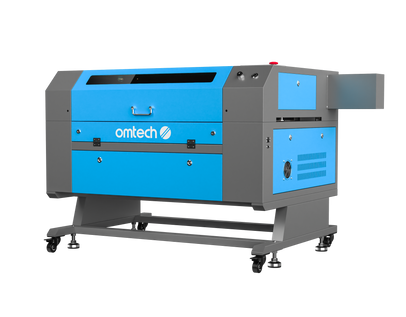
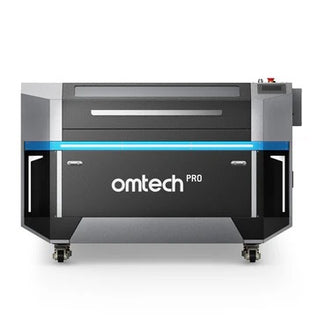
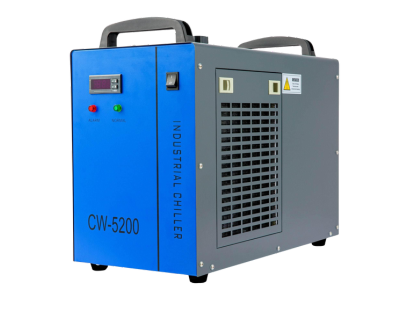
The Production Entry Point: The OMTech Pro Series 2440 (80W/100W) CO₂ Laser Engraver fits mid-sized production rooms perfectly. It provides a generous working area and includes an integrated water chiller out of the box—essential for keeping the glass tube cool during demanding production runs.
-
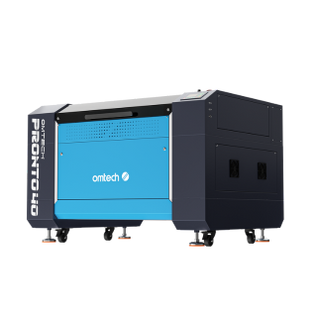
The High-Volume Alternative: For businesses processing heavy sheets of timber or thick acrylic panels for signage, stepping up to a high-wattage cabinet model like the OMTech Pro 3655 130W CO₂ Laser provides the raw cutting speed and clearance needed to scale up daily manufacturing.
Sustainability in Manufacturing: Reducing Workshop Waste
An underrated benefit of switching to laser technology is how clean it is compared to the legacy processes it replaces.
Laser systems fundamentally improve workshop sustainability metrics:
-
No Ongoing Chemical Consumables: Inkjet and pad printing setups demand constant ink refills, chemical cleaning solvents, and pad replacements. A fiber laser does not. The solid-state laser source itself is rated for up to 100,000 operational hours—giving you roughly a decade of daily workshop use before requiring major maintenance.
-
Drastically Lower Scrap Rates: Manual marking methods often cause part rejections due to smudged inks or misaligned mechanical stamps. Because a digital laser aligns precisely via software previews, human error is virtually eliminated.
-
Energy Efficiency: Solid-state fiber systems convert electrical current into light energy with incredible efficiency, consuming far less power than massive heat-based or chemical marking alternatives.
Summary: What Local Aussie Shops Are Actually Operating
You don't need a sprawling factory floor to access industrial-grade efficiency. The vast majority of market growth across Australia is driven by small, agile teams of under five people running a single, well-chosen machine between fabrication jobs.
Whether it is a regional gift boutique personalising timber pieces with a compact CO₂ setup, or a boutique engineering shop using a benchtop Galvo fiber unit to serialise structural components, the trend is clear: industrial-grade laser tech has officially scaled down to meet the footprint, budget, and everyday workflow of the local Aussie maker.
Frequently Asked Questions
What are industrial laser systems typically used for in a workshop?
They are primarily used to mark high-contrast serial numbers, component tracking barcodes, and company branding onto parts. On the cutting side, they are used to fabricate precise flat-pack components from sheet metals (via high-power fiber) or timbers, acrylics, and fabrics (via CO₂).
Can I use a fiber laser to engrave timber or plastic?
No. The 1064nm wavelength of a fiber laser passes cleanly through or burns unpredictably into most organic materials without marking them neatly. For timber, leather, acrylics, and glass, you must use a CO₂ laser system.
How long can I expect a fiber laser source to last in production?
Most commercial fiber laser sources are rated for approximately 100,000 hours of operation. This makes them incredibly durable compared to traditional CO₂ glass tubes, which generally average between 2,000 to 10,000 hours depending on the tube grade and cooling efficiency.
Is it difficult to learn how to operate a Galvo marking laser?
Not at all. Modern industrial software like EzCad2 or LightBurn features user-friendly, visual interfaces. With integrated autofocus systems taking care of the height adjustments, most workshop operators can confidently run production batches after just a few days of training.